Scoring a Loaf: How Cuts Guide Expansion
A clean score gives a shaped loaf a planned place to open. Choose a cut that suits its form, make one controlled pass, and use the baked crust to guide your next adjustment.
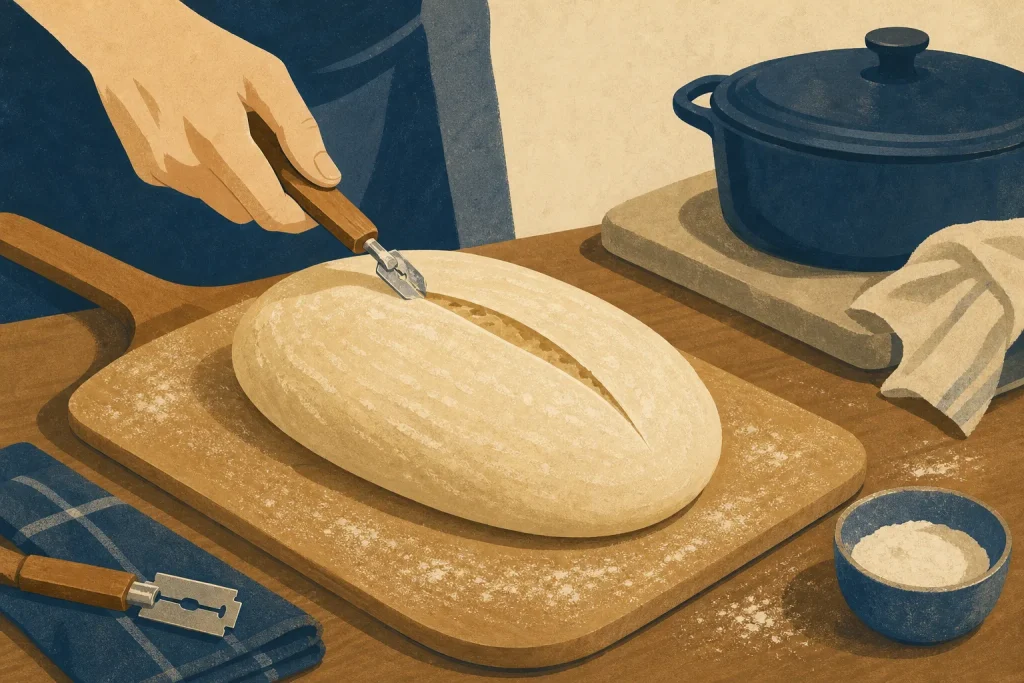
A long bâtard can split at the side if its top is left uncut, while a single deliberate slash gives the dough a clear opening to follow. The score weakens a narrow strip of the outer skin; shaping, proof and the cut’s direction all influence how the loaf expands.
Start with a simple design and a sharp blade. A lame or a razor secured in a suitable handle gives you control. The aim is a clean cut without pressing down or dragging the dough.
Which cut suits the loaf?
Match the score to the loaf’s shape. A long bâtard often suits one lengthwise slash. A boule can take a cross or a curved cut. Leave enough uncut surface around the score to support the loaf as it expands.
A cut placed off-centre may produce a lifted flap, often called an ear; a central cut is more likely to open as a seam. These are tendencies, not fixed outcomes. Dough firmness, proof and scoring method can change the result.
Say you have shaped a long bâtard and want one pronounced opening rather than a decorative pattern. You choose a single lengthwise score, set a sharp lame beside the oven, and wait until the oven and landing surface are ready. You then make one smooth pass just before loading. The expected result is a clear opening along that line; the flap may be subtle or pronounced depending on the dough and cut.
How does shaping affect the score?
Shaping draws the outer skin into a supported layer. That surface helps the loaf keep its form while the score provides a weaker route for expansion. If the dough is loosely shaped or very slack, it may spread before the cut can guide it. Scoring cannot restore structure that has already been lost.
Draw the outer skin gently into place and seal the seam underneath. Stop if the surface begins to tear. If dough sticks to the bench, use a light dusting of flour; excess flour between folds can make the seam harder to seal.
During final proof, look for a loaf that retains its shape but has relaxed somewhat. Use the cues in your recipe alongside its appearance and feel; no single touch test suits every dough. If it looks slack, transfer it carefully and keep the score simple.
How should you hold the blade?
A shallow blade angle can encourage one edge of a cut to lift into a flap, while a more upright cut often leaves a clearer seam. The effect depends on the dough and scoring method, so treat angle as an adjustment rather than a promise. For a cross or a neat central opening, a blade closer to perpendicular may suit the design.
Use a controlled depth that cuts through the outer skin without dividing the loaf’s surface more than intended. A faint scratch may close during expansion; a very deep cut can leave a broad, uneven opening. Adjust for the loaf’s size and firmness, and avoid pressing hard enough to squash it.
If sticky dough catches on the blade, first check that the edge is sharp and make one confident pass. Some bakers find a lightly dampened blade helps, but it does not suit every dough or scoring style. If it drags, stop, clean and dry the blade, then use a fresh, smooth stroke rather than sawing back and forth.
What routine keeps scoring controlled?
- Choose the design: Match the score to the loaf’s shape. If one clear opening is the aim, use a single slash; if the loaf is round and you want balanced seams, choose a simple cross.
- Prepare the blade: Check that the lame or razor is sharp, clean and secure. If it snags on a scrap of dough, replace or clean it before scoring; if it cuts cleanly, set it aside ready for use.
- Check the loaf: Look for a surface that still holds its shape. If it appears slack, transfer it gently and keep the design simple; if it remains supported, proceed with the planned score.
- Prepare the landing place: Have the peel, baking stone, steel, tray or covered baker ready before scoring. If the route to the oven is clear, score just before loading; if it is not, clear it first so the cut dough does not wait unnecessarily.
- Make the cut: Hold the blade at the angle that suits your intended opening and draw it through in one smooth pass. If the line is clean, load the loaf; if it is ragged, do not repeatedly saw over it—make a note to check blade sharpness and control on the next bake.
- Review the crust: After the loaf has cooled, check whether it opened along the score, split elsewhere or spread broadly. If it opened where intended, keep the same approach; if not, change one factor next time, such as score depth or shaping, rather than altering several at once.
Follow the baking conditions in your recipe, including any steam or covered-baker method. Score close to loading: a cut made while the oven is still unready may relax before the loaf goes in.
What can a failed opening tell you?
If the loaf bursts away from the score, check whether the planned line was clear and whether the dough held its shape. A faint cut may close during expansion; loose shaping or slack dough can also contribute to uneven splitting. Choose one factor to adjust next time so you can judge its effect.
If the score opens without a lifted flap, consider whether a shallower angle suits your chosen style, but remember that dough and method affect the outcome. If the edge looks ragged, check the blade for sharpness and make a smoother pass on the next loaf.
If the opening spreads too broadly, use a more controlled cut and check that you are not pressing down. Also look at the loaf’s shape before baking; slack dough may spread regardless of the score.
If the loaf is dense or flattened despite a clean opening, scoring is unlikely to be the main cause. The cut guides the surface; it does not replace fermentation or careful shaping.
What is not worth the effort?
Skip elaborate patterns while a plain score is still unpredictable. Extra lines can make the design harder to control, and small details may disappear as the dough expands. A clean blade and a cut suited to the loaf matter more than a complicated motif.
Keep a brief note of the loaf shape, cut and visible result. If the score opened as intended, repeat the approach; if it did not, adjust just one feature at the next bake. Consistent notes are more useful than chasing an identical flap on every loaf.
Alongside this loaf
Reading the Moves Between Turns
In an asynchronous strategy game, an opponent’s habits become visible one saved position at a time.…
Pita at the Table: The Pocket, the Puff, and the Meal
A pita pocket begins as steam trapped between quickly setting layers of dough. Follow an invented…