The Windowpane Test, and What It Cannot Tell You
A thin stretch can show whether dough is extensible, but the result depends on how you handle the sample. Use the test to answer a focused question, not to predict the finished loaf.
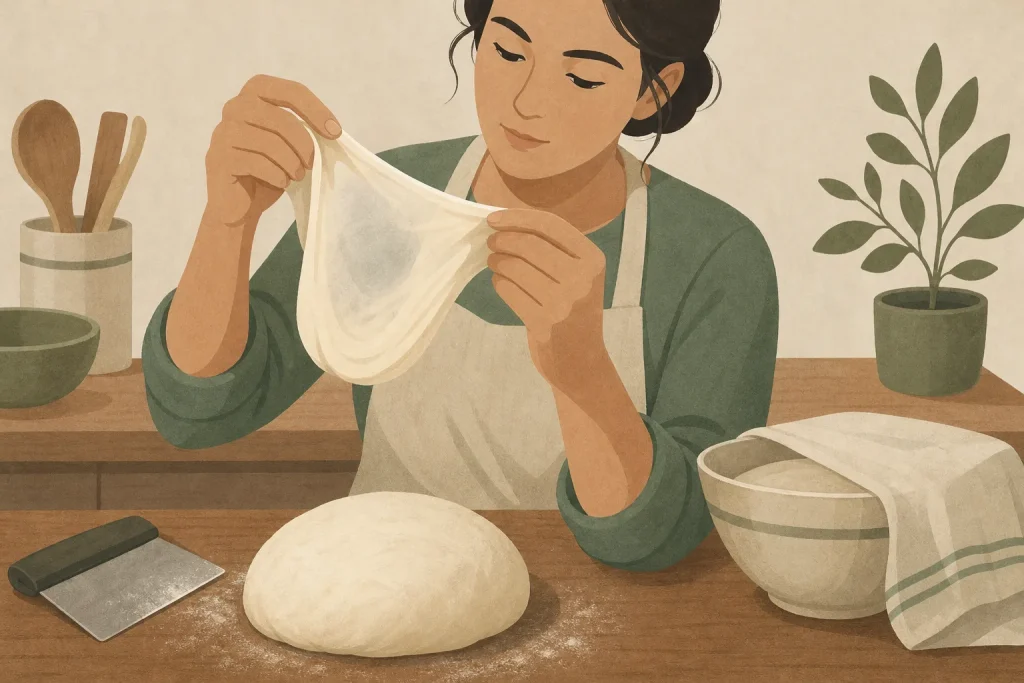
A windowpane test answers one narrow question: can this piece of dough stretch into a thin sheet without tearing straight away? It does not predict the finished loaf. Use it to check extensibility, then decide whether another test would change what you do next.
What does the test actually show?
Pinch off a small piece and ease it outward between your fingers. If it thins into a flexible membrane before breaking, the sample can stretch while holding together. That is useful information about this piece under this handling. It does not reveal why the dough behaves that way or whether the whole batch is ready for its next stage.
Light passing through the thinned dough can make the result easier to see, but a spotless, perfectly even film is not the goal. Note how readily the sample stretches and whether the tear is smooth or ragged. A sudden tear may reflect limited extensibility, but it can also result from a sharp pull or a sample that feels tight. The test alone cannot identify the cause.
How do you make the result useful?
Separate the sample cleanly with a dough scraper or clean fingers. Hold it gently, then stretch from the centre towards the edges with steady pressure, turning it as you go. Do not tug sharply or knead the sample first; either action changes what you are trying to observe.
If the sample sticks, dampen your fingers lightly rather than coating it in flour. If it tears after an abrupt pull, discard that attempt as unclear instead of treating it as a reliable result. Take another sample only if the answer would affect your next action.
- Observation: The sample stretches into a thin, flexible sheet. If it does, then note that it is extensible and follow the recipe’s next instruction; if not, consider the other observations below rather than adding work automatically.
- Observation: The sample tears immediately after a sharp tug. If the pull was abrupt, then repeat once with gentle pressure; if it still tears under a slow stretch, then treat the result as a sign to check the method and dough’s state.
- Observation: The sample feels tight and springs back before thinning. If the recipe allows a rest, then cover the dough and resume after that rest; if it is already at a stage where handling should stop, then leave it alone and follow the recipe.
- Observation: The sample sticks to your fingers. If a light film of water lets you grip it cleanly, then continue gently; if it remains too slippery to handle, then stop testing rather than burying it in flour.
- Observation: A thin membrane forms but has a small uneven patch. If the sample otherwise stretches without splitting, then record that as a useful result; if the uneven area opens into a tear, then note where it failed and consider whether the pull was uneven.
- Observation: Repeated samples produce different results. If the difference comes from handling, then stop and use a gentler, steadier stretch; if the result remains inconsistent, then rely on the recipe’s broader cues instead of testing again.
What should you do after a quick tear?
Do not respond to every tear by kneading more. First check whether you pulled too hard and whether the dough feels tight. If the recipe includes a covered rest, follow it and assess the dough at the prescribed point. If it calls for further mixing or another development stage, follow that method rather than chasing a flawless membrane.
A quick tear is an observation, not a diagnosis. It does not distinguish between a sample that was handled roughly and one that needs more development. Nor does it tell you whether the recipe expects strength to come from mixing, resting or later handling. Use the method to choose the next action.
Does a clear membrane mean the dough is ready?
No. The sample may stretch well while the whole dough still needs to follow the recipe’s next stage. The test does not tell you whether fermentation has progressed far enough, whether the dough is ready to shape or whether it will hold a particular loaf shape.
For those decisions, use the recipe’s cues for the dough as a whole. Look for the stated changes in volume, aeration or handling, and follow its timing and sequence. A windowpane can add information about stretch, but it cannot replace those checks.
When is the test not worth doing?
Skip repeated tests when the result would not change your next move. Pulling off sample after sample to achieve a glass-clear film wastes time and interrupts the method, especially when the recipe gives clear instructions for what to do next. One careful test is enough to answer a specific question; if it remains ambiguous, return to the recipe rather than testing continuously.
Say you are mixing a soft dough for a tin loaf. Your first sample tears after you pull it sharply. You cover the dough for the rest specified in the recipe, then take one fresh sample and stretch it slowly. This time it thins without splitting. The useful result is that the dough now stretches under gentle handling; you proceed to the recipe’s next stage, while still using its fermentation cues to decide when that stage is complete.
Keep the test in its proper role: it describes how a small sample stretches at one moment. The practical value lies in making that observation carefully, then choosing a next action from the recipe rather than asking the sample to forecast the loaf.
Alongside this loaf
Reading the Moves Between Turns
In an asynchronous strategy game, an opponent’s habits become visible one saved position at a time.…
Pita at the Table: The Pocket, the Puff, and the Meal
A pita pocket begins as steam trapped between quickly setting layers of dough. Follow an invented…